How to Find a High-Quality Meme Coin Entry in 2026 Without Chasing the Pump
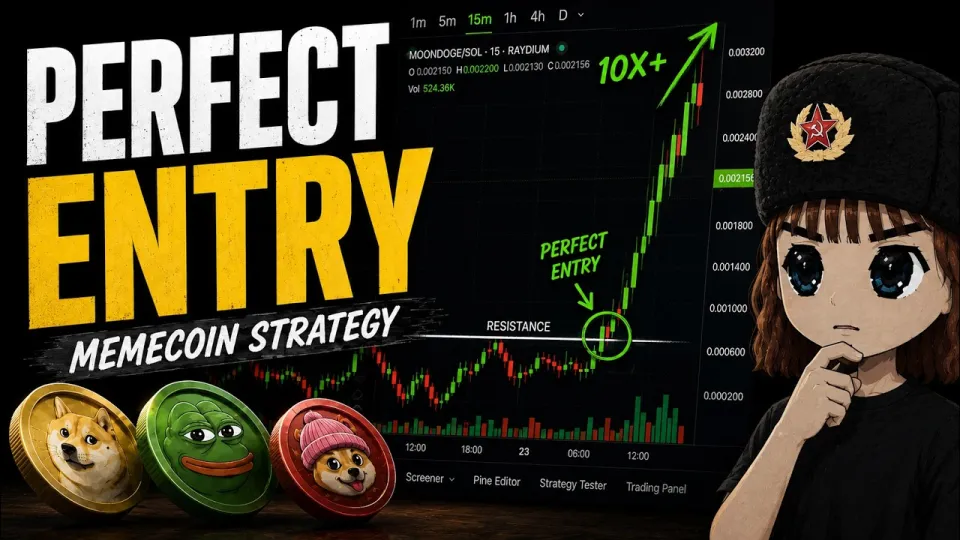
Video: How I Find the PERFECT Entry on Memecoins 📈 (Full Strategy)
Need articles like this for your video? They help promote it on YouTube and Google — order them in the Telegram bot @sat_sit_bot. The bot writes and publishes the articles itself (with your YouTube video embedded) on popular topical websites (no ads). Try it free: 50 articles on us.
Key takeaways
- Most meme coin losses come from timing, not from picking the wrong ticker.
- A valid entry needs three confirmations: momentum, a pullback or support retest, and a defined invalidation level.
- Chasing a vertical green candle raises the stop distance and destroys the risk-to-reward ratio.
- Signals to skip a trade: fading volume on new highs, long upper wicks, and a chart that already ran 3–5x.
- Risk, exits and profit-taking are planned before the buy, not after the price moves.
A meme coin entry is a planned buy at a specific chart level with a predefined invalidation point, not a reaction to a green candle. The work happens before you click buy: confirm momentum, wait for a pullback or support retest, and size the position so the stop sits at a level that would actually prove the setup wrong. Traders who want the same toolkit in one place can get early access and setup help through the Plasma Telegram channel.
Why meme coin entries fail more often than coin selection
Picking a token with a live narrative is the easy half; the entry price decides whether the trade is worth taking at all. A coin that goes on to double can still produce losing traders if they bought the top of a vertical candle with a stop 40% below. The same coin bought on a controlled pullback with a 12–15% stop turns the identical move into a positive risk-to-reward trade. That asymmetry is the whole argument for treating entry as a process rather than an impulse.
Memecoin charts on Solana and similar chains are thin, fast and reflexive: a single large wallet can print a wick that liquidates late buyers, and liquidity can vanish between the bid and the ask. Because of that, entry quality has to be judged on structure — higher lows, volume behaviour, how price reacts at prior resistance — rather than on how exciting the last five minutes looked.
The three confirmations behind a high-quality meme coin entry
A high-quality meme coin entry setup requires momentum, a constructive pullback, and a clear invalidation level, all visible before the trade is taken. Missing any one of the three turns the trade into a guess.
- Momentum confirmation. Volume expands as price breaks a prior local high, and the candle closes above that level rather than wicking through it. Rising volume with rising price is the baseline; price up on falling volume is a warning.
- Pullback or retest. After the breakout, price comes back to the broken level, a moving average, or a higher-low zone. The retest is where the entry improves: the stop moves closer and the position size can grow for the same dollar risk.
- Invalidation level. Decide in advance which price proves the idea wrong — typically below the higher low that defined the setup. If that level is too far from the entry to justify the trade, the setup is skipped, not widened.
How to read momentum without chasing the pump
Momentum is useful information, but only when you enter after it has been confirmed and digested, not while the candle is still vertical. A coin that has printed five consecutive green candles with no pause is a bad entry regardless of how strong the narrative is, because the nearest logical stop is far away and the first pullback often retraces most of the move.
The practical filter is simple: if the distance from the current price to the nearest structural support is larger than the distance to your target, there is no trade. Waiting for a consolidation — a tight range, a shallow flag, or a series of higher lows — compresses the stop and makes the same move profitable. Patience here is not a personality trait; it is the mechanical consequence of measuring risk before entry.
Using pullbacks and support levels to improve entries
Support levels are where meme coin entries get their edge, because they define both the entry price and the stop in a single decision. Look for the level that already rejected price once: a prior breakout point, the base of the previous consolidation, or a round-number zone where large orders tend to sit.
- First pullback after a breakout — the highest-quality version, since holders from the base are still in profit and sellers are mostly short-term.
- Higher-low retest — price makes a low above the previous low, showing buyers are stepping in earlier each time.
- Failed breakdown — price dips under support and reclaims it within the same session, trapping sellers and often producing the sharpest continuation.
Entering at these levels rather than at the high of a candle typically cuts the stop distance by half or more, which is the single biggest improvement most beginners can make to their results.
Chart signals that say do not enter
Some charts look exciting and are still uninvestable, and recognising them is as valuable as spotting a good setup. The most common red flags are a long upper wick on record volume (distribution into strength), a new high printed on visibly lower volume than the previous one (momentum divergence), and a chart that has already run several multiples without any consolidation. A token that went from launch to a 3–5x in a short window has most of its easy upside behind it and its downside ahead.
Other signals worth respecting: liquidity that is too thin to exit a position without moving price, a holder base concentrated in a handful of wallets, and a chart that only moves on announcements rather than on organic flow. None of these guarantee a loss, but each one lowers the quality of the entry and should reduce position size or cancel the trade outright.
Planning risk, exits and profit-taking before the buy
Risk planning happens before the order, and it has three numbers: entry, invalidation, and the first target. Position size is then derived from the distance between entry and invalidation, so that a single loss stays within a fixed percentage of the account — commonly 1–2% per trade for memecoins given their volatility.
Profit-taking is staggered rather than all-or-nothing. A typical structure sells a portion into the first resistance or on the first strong vertical move, takes more at the next level, and leaves a runner with the stop moved to breakeven. This locks in gains while keeping exposure to the tail outcome that makes memecoin trading worthwhile. Exits written down in advance are also the only reliable defence against the two emotional errors that destroy accounts: holding a loser hoping for a bounce, and selling a winner too early out of fear.
Common questions from newer meme coin traders
Beginners tend to ask the same things: which trackers and filters to use, how to catch coins before announcements move them, whether the same approach works on every chain, and how much capital is reasonable to start with. The honest answers are less glamorous than the questions. Filters help with discovery, not with entry timing; announcement-driven moves are usually already priced in by the time a retail trader sees them; chain choice changes liquidity and tooling more than it changes chart structure; and starting capital should be money whose loss would not change your life. The recurring theme in viewer feedback is that entry timing is the part almost nobody explains — which is exactly why it deserves its own checklist.
Useful links
- Plasma Telegram (early access, updates, setup help): https://t.me/+PF-2KHPgQqFiZWJh
- Discord community: https://discord.com/invite/fr6zzYyBxC
- Padre terminal via star: https://trade.padre.gg/rk/star
- Solpump: https://solpump.com/a/STARGOAT
- Axiom trading terminal: https://axiom.trade/@stargoat
- GMGN VIP access: https://gmgn.ai/r/stargoat
- Author on X: https://x.com/starwifpump
- Author on Kick: https://kick.com/startrades
Final thoughts on building a repeatable meme coin entry process
The goal is not to predict every move but to make the same good decision repeatedly: confirm momentum, wait for the pullback, define the invalidation, size the position, and take profit in stages. That process removes most of the FOMO that pushes traders into bad prices, and it makes results reviewable instead of random. The full breakdown of this approach comes from the starwifpump channel, which walks through chart setups and entry logic in detail. If you want the tooling and community around it, join the Plasma Telegram for early access and keep the checklist next to your chart.
Source: How I Find the PERFECT Entry on Memecoins 📈 (Full Strategy) · Markdown version
Questions & answers
What is the best moment to enter a meme coin?
The best entry usually comes on the first pullback or retest after a confirmed breakout, not during the vertical candle itself. At that point the stop can sit just below a defined structural level, which keeps the risk small relative to the potential move. If the nearest support is far from the current price, the setup is better skipped.
How do I avoid FOMO when a meme coin is pumping?
Measure the distance from the current price to the nearest structural support before buying. If that distance is larger than the distance to your target, there is no trade regardless of how strong the narrative looks. Writing the entry, stop and first target down before placing an order makes the decision mechanical instead of emotional.
Which chart signals mean I should not enter a meme coin?
Long upper wicks on record volume, new highs printed on declining volume, and charts that already ran several multiples without consolidation are the main warnings. Thin liquidity and a holder base concentrated in a few wallets also lower entry quality. Any of these should either cancel the trade or cut the position size.
Does the same entry strategy work on every chain?
Chart structure — momentum, pullbacks, higher lows, invalidation levels — behaves similarly across chains, because it reflects how buyers and sellers react to price. What changes is liquidity, tooling and speed of execution, which affect position sizing more than setup selection. Thinner markets require smaller size and wider tolerance for wicks.